- Written by: Michael Kill, NTIA, CEO
- Full Nightlife Article Newsletter series.
In an age where we can message someone across the world in seconds, it’s striking how many people feel more disconnected than ever, particularly in the spaces designed to bring us together: bars, clubs, and music venues. Nightlife, long considered the beating heart of social interaction, is undergoing a quiet shift. Among the beats, lights and curated vibes, a paradox has emerged: we’re surrounded by people, yet many of us struggle to truly connect. Has nightlife, once a vibrant arena of real-world conversation and connection, begun to reflect the same social distance we experience online?
Over the past twenty years, technology has reshaped how we relate to one another. Texting, social media, and instant messaging have made communication faster, but also more filtered. We edit, curate, delete. What we gain in convenience, we lose in spontaneity. In nightlife, this tension is increasingly visible. The unspoken glance across the bar, the chance conversation with a stranger, the intimacy of the dancefloor, these once-common encounters are becoming less frequent, and for some, more daunting.
The modern social landscape has created what could be termed a ‘communication gap’. Is the rising discomfort in face-to-face situations a symptom of clinical social anxiety, or simply unfamiliarity? For many, it’s the latter. Young people growing up behind screens often have fewer opportunities to develop the intuitive skills that come with real-life conversation: reading body language, holding eye contact, navigating awkward silences. Adults too, particularly those working remotely or spending significant time online, may find themselves unexpectedly out of practice.
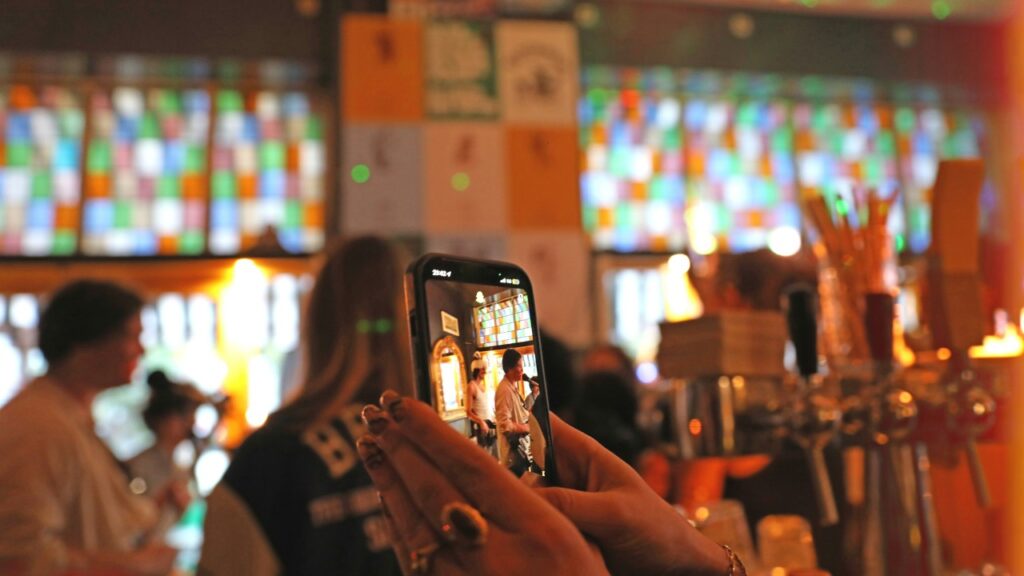
This is especially significant in the context of nightlife, where social spontaneity is meant to flourish. For decades, the night-time economy has served as a vital outlet for emotional expression, community-building and personal discovery. But the rise of digital habits is subtly changing the way these spaces are used. The club, the gig, the bar, they’re still places we gather, but increasingly also stages for content creation. Phones are out, moments are captured, and experiences are often filtered for the feed rather than lived in full.
That doesn’t mean connection is impossible, far from it. Nightlife still holds immense potential to counteract digital disconnection. But doing so requires intention. Venue owners, promoters and event organisers have an opportunity to rethink how social spaces function. This might mean reintroducing quieter areas for conversation, designing events that prioritise interaction over performance, or simply encouraging a culture where it’s normal to talk, to listen, to be present.
It’s important to remember that face-to-face communication isn’t just about what we say. Our expressions, gestures, tone of voice, and even pauses carry meaning. In a nightclub, these cues can be even more powerful, think of how much can be conveyed in a look, a dance, a shared laugh. When these social tools go unused, we shouldn’t assume people are broken, we might simply be witnessing a lack of practice.
There’s a role for empathy here. Not everyone who struggles to engage in person is experiencing deep anxiety. Sometimes, it’s just discomfort born of unfamiliarity. Rather than pathologising these experiences, we can treat them as skills to be nurtured. The more opportunities people have to connect face to face, without pressure or performance, the more confident they’ll become.
Nightlife, in this sense, can be more than entertainment. It can be a site of social rehabilitation. By creating spaces that value conversation alongside music, and connection alongside content, we help people rediscover the power of presence.
We haven’t lost the ability to speak face to face, but we may need to consciously reclaim it. Like dancing, like DJing, like any craft, human connection improves with practice. And nightlife, with all its diversity, energy and unpredictability, remains one of the richest places to practise.
Because despite all the apps, cameras and content, the most powerful moments are still the ones shared between people, in real time, in real space.
And nightlife, at its best, reminds us of that.