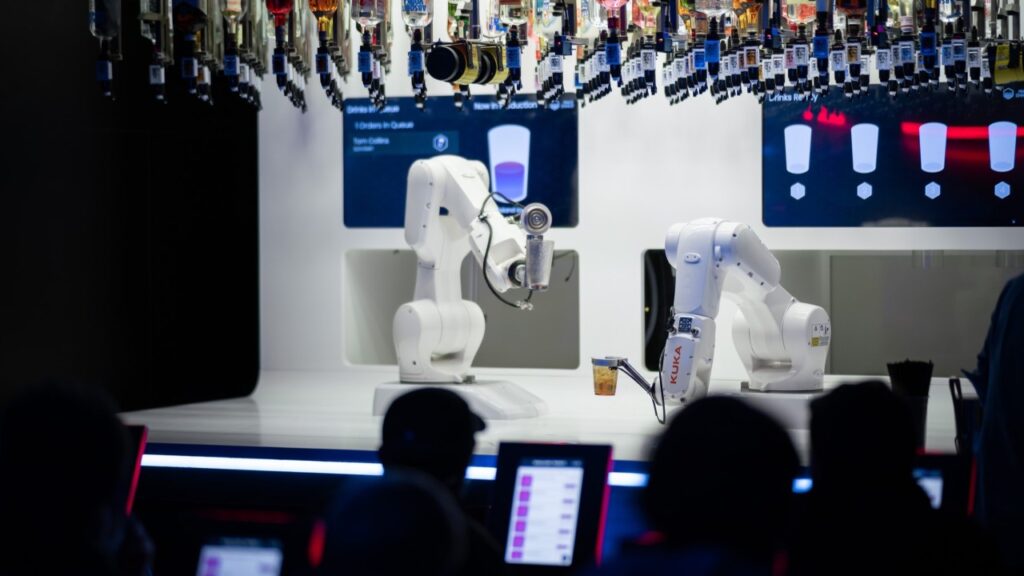
Walk into a sleek airport lounge, a futuristic hotel bar, or even certain high-end venues in London today, and you might be served not by a person, but by an AI-powered robotic system. A mechanical arm glides with precision, measuring spirits to the millilitre, shaking cocktails flawlessly, and executing recipes without hesitation. The question that naturally follows is both intriguing and unsettling: will AI and robots eventually replace bartenders altogether?
At first glance, the idea feels increasingly realistic. Artificial intelligence and robotics are already reshaping industries from manufacturing to customer service, and hospitality is firmly within their reach. AI-driven bartending systems can operate continuously without fatigue, deliver perfect consistency, and significantly reduce labour costs. In environments where speed and efficiency outweigh personality, such as large-scale events, cruise ships, or busy airports—robots present a compelling alternative. They do not call in sick, they do not get tired, and they can process orders with remarkable speed and accuracy.
Yet bartending has never been just about making drinks. A great bartender is part mixologist, part host, part psychologist. They read the room, understand moods, and adapt in real time. Whether recommending a drink based on subtle preferences, offering a listening ear, or bringing energy to a lively night, bartenders provide something deeply human. This emotional intelligence is precisely where AI still struggles.
Of course, AI is advancing rapidly. Modern systems can recognise speech, respond conversationally, and even simulate personality. Some can remember customer preferences or suggest drinks based on data. But there is still a noticeable gap between simulation and authenticity. Customers often sense when interactions are programmed rather than genuine. In a social setting like a bar, that difference matters.
There is also the cultural dimension. In the UK especially, pubs and bars are more than places to drink, they are social anchors. The familiar face behind the bar often becomes part of the community. Regulars build relationships, conversations flow naturally, and trust develops over time. Replacing that with a machine risks stripping away a key part of what makes nightlife meaningful.
That said, it would be unrealistic to ignore the growing role of AI and robotics. Rather than full replacement, a more likely outcome is integration. AI systems could handle repetitive tasks, measuring, pouring, inventory tracking, even predicting demand, while human bartenders focus on interaction, creativity, and experience. In this model, technology enhances rather than replaces the role.
Cost remains a major consideration. While AI and robotic systems promise long-term savings, the upfront investment is significant. Installation, maintenance, and software updates are expensive, making them more viable for large chains or premium venues than for independent bars. For many businesses, skilled human bartenders are still the more practical option.
There are also real-world limitations. Bars are unpredictable environments. Drinks get changed mid-order, glasses break, customers behave unpredictably, and situations evolve constantly. Humans adapt instinctively to these moments. AI systems, despite their sophistication, still rely on structured inputs and controlled conditions. The chaotic energy of a busy Friday night is not easily managed by algorithms.
Customer perception is another key factor. While some people are drawn to the novelty of AI bartenders, others find the experience cold or impersonal. Being served is part of the overall experience, and for many, a human interaction is essential. Novelty may attract attention, but it does not always build loyalty.
Interestingly, the rise of craft cocktails and personalised experiences has reinforced the importance of human bartenders. Consumers increasingly value storytelling, creativity, and bespoke service, areas where humans excel. A bartender who can craft something unique, explain its origins, and tailor it to individual tastes offers something AI cannot fully replicate.
Looking ahead, the question is less about replacement and more about transformation. AI and robotics will undoubtedly reshape bartending, just as previous technologies have. But history suggests that technology rarely eliminates roles entirely, it changes how they function.
In the end, bartending is about connection. It is about atmosphere, personality, and shared experience. AI and robots may take on a larger role behind the bar, bringing efficiency and precision, but they are unlikely to replace the human element that defines nightlife.
So, will AI and robots replace bartenders? Not entirely. What they will do is change the role, automating the routine, enhancing efficiency, and pushing bartenders to focus on what machines cannot replicate: genuine human connection.